

A chocolate truffle is a small chocolate with a soft center. The center is usually ganache, a smooth mix of chocolate and cream, and the outside is rolled in cocoa powder or sealed in a thin chocolate shell. It’s named after the truffle fungus it looks like.

On this page: What it’s made of · Ganache vs truffle · Ganache ratios · How to make them · Ways to change them · Styles · Who invented it · How long they keep · How to store them · Dairy-free? · Our truffles
What is a chocolate truffle made of?
A soft center and a coating. The center is almost always ganache, which two food scientists, writing in the Journal of Food Science in 2018, define simply as “a mixture of chocolate and dairy.” Cream is the usual dairy, and makers flavor it with things like coffee, fruit, spices or liqueur. The coating is cocoa powder, chopped nuts or a thin shell of chocolate.
Ganache melts at a lower temperature than plain chocolate, the same study explains, because milk fat from the cream mixes with the cocoa butter. That’s why a good truffle center goes soft almost the moment it touches your tongue.

What’s the difference between ganache and a truffle?
Ganache is the mixture; a truffle is one of the things you make with it. The same chocolate and cream, in different proportions, also becomes a cake glaze, a frosting or a filling between cake layers. A truffle uses the firmest version, so it holds a shape you can roll or pipe.
How much cream goes into truffle ganache?
About 1 part cream to 2 parts dark chocolate, by weight, which makes a ganache firm enough to roll or pipe, says the baking teacher Baker Bettie. A 2024 review of ganache research in the journal Foods gives the same 2 to 1 for dark and semisweet chocolate, and about 2½ or 3 to 1 for milk and white chocolate, which set softer.
| Use (dark chocolate unless noted) | Chocolate to cream, by weight |
|---|---|
| Truffle centers | 2 : 1 |
| All-purpose ganache | 3 : 2 |
| Frosting or thick glaze | 1 : 1 |
| Pourable glaze | 1 : 1½ |
| Milk or white chocolate, for truffle centers | About 2½–3 : 1 |
Sources: Baker Bettie (truffle centers, frosting, glaze); King Arthur Baking (all-purpose); Lapčíková et al., 2024 (milk and white).
How do you make chocolate truffles?
Make a firm 2 to 1 ganache, let it set, then scoop and roll it. This is our basic recipe, built from Baker Bettie’s, Sally’s Baking Addiction’s and America’s Test Kitchen’s. It makes about 25 small truffles.
Ingredients
- 8 ounces (227 g) dark chocolate, 60 to 70%, chopped fine
- ½ cup (120 ml, about 115 g) heavy cream
- A pinch of salt
- About ¼ cup cocoa powder, for rolling
Steps
- Put the chopped chocolate and salt in a heatproof bowl.
- Heat the cream in a small saucepan until it just simmers, with small bubbles around the edge, and pour it over the chocolate.
- Leave it alone for 3 to 5 minutes so the chocolate softens. Stirring while the cream is too hot can make the ganache split and turn oily.
- Stir gently with a spatula, starting in the center with small circles and working outward, until it’s smooth and glossy. America’s Test Kitchen stirs rather than whisks, because whisking beats in air that can make ganache grainy.
- Let it set at room temperature until it’s firm enough to scoop, about 2 hours; America’s Test Kitchen found that this keeps the texture smoother than chilling it right away. In a warm kitchen, finish it in the fridge.
- Scoop heaping 2-teaspoon mounds onto a parchment-lined tray and chill them for 20 to 30 minutes.
- Roll each mound between your palms into a ball, then roll it in cocoa powder. Dusting your hands with cocoa keeps the ganache from sticking.

Use chocolate you’d happily eat on its own, since it’s most of the truffle. Any of our 70% bars works; four of them make about 8 ounces.

How can you change the basic truffle?
Six ways, using the basic recipe above.
1. Silkier
America’s Test Kitchen adds corn syrup and butter to its ganache: the corn syrup keeps the sugar in the chocolate from turning gritty, and the butter makes it silkier. For the basic recipe, warm about 1 tablespoon of light corn syrup with the cream, and stir in 1 tablespoon of soft butter once the ganache is smooth.
2. Infused
Warm the cream with a flavoring until it steams, take it off the heat, cover it and let it steep, then strain it, top it back up to ½ cup with fresh cream, and bring it to a simmer before it goes over the chocolate. These are the flavors we pair with our bars, with amounts for the ½ cup of cream:
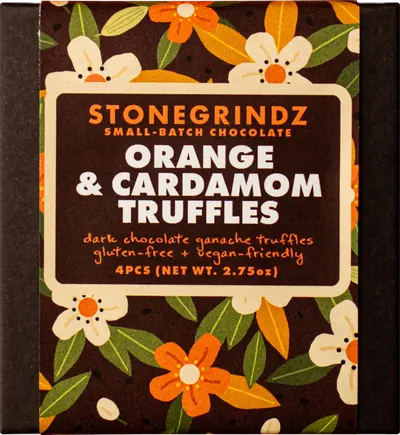
- Cardamom and orange, for a Madagascar chocolate like our Ambanja 70%: 2 cracked cardamom pods and a strip of orange peel, 5 minutes.
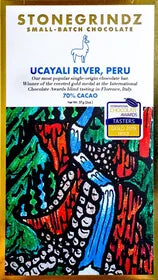
- Earl Grey, for a Peru chocolate like our Ucayali River 70%: 1 tea bag, 4 minutes.
- Cinnamon and chile, for an 85% chocolate like our Ancient Ecuador: a 1-inch piece of cinnamon stick and a pinch of cayenne, 10 minutes. Use the amounts in number 4 below.
- Chai, from America’s Test Kitchen’s chai truffles: 2 chai tea bags, 5 minutes.

3. Spiked
Stir 1 to 2 tablespoons of bourbon, dark rum or orange liqueur into the ganache at the end of step 4, once it’s smooth. The chocolatier Jacques Torres adds it last like this so the flavor doesn’t cook off.
4. With 85% dark chocolate
Darker chocolate has more cocoa solids and less sugar, so it sets firmer, and it takes less chocolate for the same amount of cream. No recipe we found uses 85%, so this is our starting point: 7 ounces (200 g) of 85% chocolate, such as our Ancient Ecuador, to the ½ cup of cream, with 1 tablespoon of honey warmed in the cream. Valrhona, the French chocolate maker, adds honey to its truffle ganache too. If the set ganache is too firm to scoop, warm it gently and stir in a spoonful of warm cream.
5. Dipped in chocolate
For a crisp coat, roll the centers into balls but skip the cocoa, and dip them in tempered chocolate; about 12 ounces (340 g) of chocolate gives you enough depth to dip 25 truffles. Tempering means melting and cooling chocolate in a controlled way so it sets shiny and snaps; untempered chocolate sets dull and soft. Our Dubai chocolate guide has an easy way to do it at home, in the part on making a bar that snaps. To check it, smear a little on parchment: tempered chocolate sets shiny and firm within about 5 minutes at cool room temperature.
If you want a nib coating, make it before you start dipping. Scaled down from Valrhona’s, it’s a little under 1 cup (100 g) of cacao nibs, 2 tablespoons of muscovado or dark brown sugar and a pinch of flaky sea salt, pulsed in a food processor until finely chopped. The dipping steps follow the chocolate maker Cacao Barry’s method:
- Let chilled centers warm to cool room temperature first.
- Drop a center into the chocolate, lift it out with a fork, and tap off the extra.
- For a cocoa or cacao nib coat (nibs are crushed roasted cacao beans), roll it in the coating right away, while the chocolate is wet. Otherwise, slide it straight onto parchment.
- Leave the truffles about 15 minutes at room temperature to set before they go anywhere cold.

6. Shelled, like ours
The professional route, and how we make ours. Fill a mold with tempered chocolate, pour out the extra to leave a thin shell, and let it set. Pipe in ganache no warmer than room temperature, to about 2 mm below the rim, let it set somewhere cool for at least 12 hours, then seal it with more chocolate, as Cacao Barry describes. It takes molds and practice, and the tempered shell is what gives a shelled truffle its snap.
What are the different kinds of chocolate truffles?
Most fall into two families. Rolled truffles are scoops of firm ganache rolled in cocoa powder, nuts or grated chocolate, which gives them their lumpy, fungus-like look. Shelled truffles, sometimes called bonbons, are ganache or another soft filling piped into a thin chocolate shell and sealed, which gives a smooth, glossy dome and a snap before the soft center. Dipped truffles sit in between: a rolled center with a thin coat of chocolate.


Ours are shelled, filled with ganache or soft caramel.
Who invented the chocolate truffle?
The usual story credits Louis Dufour, a confectioner in Chambéry, France, who is said to have made the first ones one December in the 1890s, but even French writers on the subject call that a legend. What’s documented is his advertising: the French news site Slate.fr found Dufour advertising “truffes royales” in 1894, and an 1899 ad calling him “inventeur des truffes de Chambéry,” the inventor of Chambéry truffles. That makes his the best-documented claim.
The earliest recipes on record weren’t ganache. The earliest French recipe Slate.fr found, from 1910, is just melted chocolate, cooled, cut and rolled in grated chocolate; recipes from 1929 and 1936 add lots of butter and egg yolk. Ganache itself is said to have been created in Paris around 1850, and nobody knows where its name comes from, according to the Online Etymology Dictionary.
The cocoa-dusted truffle reached London in 1902, when an Antoine Dufour opened the chocolate shop Prestat there; accounts differ on whether he was Louis’s son or his brother. The English word “truffle” for the chocolate wasn’t recorded until 1926, the Online Etymology Dictionary says, so the name caught on in English after the sweets did.
How long do chocolate truffles last?
Professionally made ganache with fresh cream usually keeps about two to three weeks, and ganache with more water in it, from extra cream or fruit purée, less than two, according to the 2024 review in Foods. The water is what eventually lets molds and yeasts grow, so makers who want a longer shelf life add ingredients that hold on to water, like invert sugar, glucose syrup or alcohol.
Homemade rolled truffles keep less time: about 3 to 4 days covered at room temperature, 2 weeks in the fridge or 3 months in the freezer, says Sally’s Baking Addiction. Shelled truffles like ours keep longer, because the chocolate shell seals the center: ours keep 14 days at room temperature, or up to 2 months in the fridge, so the fridge is the place for any you’re saving.

How should you store chocolate truffles?
Cool, sealed and away from strong smells, and eaten at room temperature, when the center is at its softest. Move homemade truffles to the fridge after 3 or 4 days. Ours are fine at room temperature for up to 14 days; after that, the fridge. Keep them sealed in there, and let them warm up before you open them. Our storage guide has the details, and why chocolate turns white explains the haze filled chocolates can get.
Are chocolate truffles dairy-free?
Classic ones aren’t, because ganache is made with cream. Some makers swap in a plant milk; a few of our ganache truffles are made with oat milk, and each listing says exactly what’s in it.
How are our truffles made?
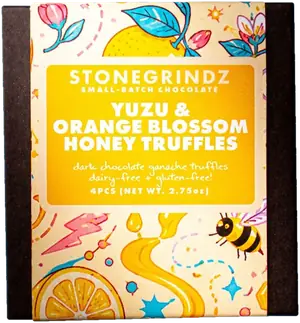
We start with chocolate we make ourselves, from organically farmed cacao beans we roast and stone-grind here in Arizona. Our tiny team makes every ganache and caramel from scratch and pipes it into shells of that chocolate, in small batches. Every Thursday brings a new ganache truffle and a new caramel truffle, and they often sell out.

Browse our truffles and our chocolate caramels; a lot of our caramels start with brown butter. The signup at the bottom of this page is the easiest way to hear each week’s flavors first.
Keep reading: Why does chocolate turn white? · What is Dubai chocolate? · The Cacao Library
Sources
- McGill J, Hartel RW, “Investigation into the Microstructure, Texture and Rheological Properties of Chocolate Ganache,” Journal of Food Science 83(3), 2018, read Oct 31, 2026.
- Lapčíková B, et al., “Chocolate Ganaches: Formulation, Processing and Stability in View of the New Production Trends,” Foods 13(16), 2024, read Oct 31, 2026.
- Kristin Hoffman, “How to Make Ganache,” Baker Bettie, read Nov 1, 2026; PJ Hamel, “How to make ganache,” King Arthur Baking, Feb 13, 2019, read Oct 31, 2026.
- Lucie de la Héronnière, “La vraie recette des truffes au chocolat,” Slate.fr, read Nov 1, 2026.
- Online Etymology Dictionary, “truffle” and “ganache,” read Oct 31, 2026.
- Sally’s Baking Addiction, “Homemade Chocolate Truffles” (4.7 from 125 reviews); America’s Test Kitchen (Cook’s Illustrated), “Chocolate Truffles” (4.2 from 53) and America’s Test Kitchen, “Chocolate Chai Truffles,” read Nov 1, 2026.
- Valrhona, “Chocolate truffles” and “Intense Manjari Truffles” (nib coating), read Nov 1, 2026.
- Ricardo, “Cacao percentages,” read Nov 1, 2026.
- Food Network Kitchen, Chocolate Truffles (spirits); Jacques Torres, Chocolate Truffles, read Nov 1, 2026.
- Cacao Barry, techniques for tempering by seeding, coating and molding bonbons, read Nov 1, 2026.
- Our product listings, truffle collection and storage guidance, read Nov 1, 2026.


