

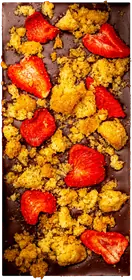
Melt good dark chocolate gently, spread it about ¼ inch thick on parchment, scatter your toppings and chill it until firm, about 15 minutes in the fridge. Then break it into shards. The three versions below are adapted from well-loved recipes by Cookie and Kate and Sally’s Baking Addiction, with tips from Ina Garten and Baker Bettie, and finished with the cacao nibs we roast in Arizona.

On this page: What you need · Which chocolate · Cacao nib and sea salt bark · Pistachio and cranberry bark · Layered peppermint bark · Tempering · If it turns grainy · How long it keeps · As a gift
What do you need to make chocolate bark?
Good chocolate, about a cup of toppings, a rimmed baking sheet, parchment paper, a microwave-safe bowl and a sharp knife for chopping.
The usual ratio is 340 g (12 ounces) of chocolate to about a cup of toppings in all, using two to four kinds and mixing sweet with salty.

What chocolate should you use for bark?
Use a bar you’d happily eat on its own, somewhere between about 60% and 85% cacao. Bark is mostly chocolate, so its flavor carries the whole thing.
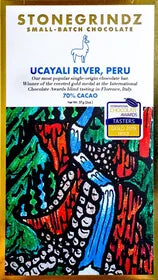
Mixing two dark chocolates gives the bark more depth; Ina Garten melts a semisweet and a bittersweet together in equal parts. With our bars, weigh out half Ucayali River, Peru 70%, which is tangy and nutty with dark cherry among its tasting notes, and half Ancient Ecuador 85%, which is fudgy and not very sweet. A kitchen scale makes the split easy.
How do you make cacao nib and sea salt bark?
This is the simplest version: dark chocolate, crunchy roasted nibs and a little flaky salt. It follows Cookie and Kate’s method, with nibs in place of the nuts.
- Line a rimmed baking sheet with parchment paper.
- Chop 340 g of dark chocolate and put it in a microwave-safe bowl. Heat it in 20- to 30-second bursts, stirring after each one. When it’s about 90% melted, stop heating and keep stirring until the last pieces disappear.
- Pour the chocolate onto the parchment and spread it about ¼ inch thick. It won’t reach the edges of the pan, and it doesn’t need to.
- Scatter 60 g (½ cup) of cacao nibs over the top (nibs are intense, so half a cup is plenty) and press them in lightly. Crush ½ teaspoon of flaky sea salt between your fingers and sprinkle it on.
- Chill the pan flat in the fridge for about 15 minutes, until the chocolate is completely firm. Break it into about 25 pieces.

Our Cacao Nibs from Ecuador are nothing but roasted Ecuador cacao, cracked and winnowed.
From our kitchen: we make the nibs the same way we start every bar. We give the Ecuador beans a medium roast, the same one Ancient Ecuador 85% gets, then crack them and blow the papery shells away, so all that’s left is the crunchy center of the bean. That roast gives them a deep, toasty flavor, and they stay crisp on top of the bark.
How do you make pistachio and cranberry bark?
Use the same method with green pistachios, red cranberries and a few nibs for crunch. It’s the holiday version, green and red.
- Line a rimmed baking sheet with parchment. Roughly chop 60 g (½ cup) of shelled, roasted, unsalted pistachios; the bark gets its salt from the flaky salt on top.
- Melt 340 g of chopped dark chocolate in short bursts, stirring each time, exactly as in the recipe above.
- Spread it about ¼ inch thick on the parchment.
- Scatter the 60 g of pistachios, 28 g (¼ cup) of dried cranberries and 30 g (¼ cup) of cacao nibs over it, then ½ teaspoon of flaky sea salt. Press everything in lightly.
- Chill about 15 minutes, until firm, and break it into shards.
Dried cherries work in place of the cranberries; they’re one of the swaps Cookie and Kate lists. With Ucayali River in the mix, cherries also echo the dark cherry flavor in that bar.
How do you make layered peppermint bark?
This is the showstopper, and two-thirds of it is white chocolate: a layer of dark chocolate between two layers of white, topped with crushed peppermint and cacao nibs. It follows Sally’s Baking Addiction’s three-layer method, where a little oil keeps each layer easy to spread and each layer chills before the next goes on.
Use a white chocolate bar made with cacao butter, not white chips, which are made to hold their shape and melt less smoothly. White chocolate also scorches faster than dark, so keep its bursts short.
- Line a baking sheet with parchment. You’ll spread each layer to about 8 by 12 inches, and you’ll use 1½ teaspoons of coconut oil in all, ½ teaspoon per layer.
- Melt 170 g of chopped white chocolate with ½ teaspoon of coconut oil in 20-second bursts, stirring hard after each one. Stir in ¼ teaspoon of peppermint extract, spread it thin and smooth, and chill 10 to 15 minutes, until it’s almost set.
- Melt 170 g of chopped dark chocolate with ½ teaspoon of coconut oil the same way. Stir in ¼ teaspoon of peppermint extract, pour it over the white layer, spread it evenly and chill another 10 to 15 minutes, until it’s almost set.
- Melt another 170 g of white chocolate with the third ½ teaspoon of coconut oil, with no extract this time, and spread it over the dark layer.
- Right away, scatter 30 g of crushed peppermint sticks (two or three) and 15 g (2 tablespoons) of cacao nibs over the top.
- Refrigerate about an hour, until fully set. If it has been in the fridge longer than 3 or 4 hours, let it sit out 10 to 15 minutes before you break it.
Do you have to temper chocolate for bark?
No. Tempering is a careful melting and cooling that makes the cacao butter set in its most stable form, the one that gives a glossy shine and a crisp snap. None of these recipes ask for it.
Untempered bark sets well in the fridge, but it gets a little soft at room temperature, and over time it can turn streaky or gray. That haze is called bloom; it’s harmless, and why chocolate turns white explains it.
Why did my melted chocolate turn thick and grainy?
Usually it got too hot. Chocolate overheats easily, and when it does it seizes, turning thick and grainy instead of smooth and pourable. That’s why every recipe here melts it in short bursts and finishes melting it by stirring.
Short bursts of 20 to 30 seconds keep it from overheating. If you’d rather use a double boiler, set the bowl over barely simmering water and stir often. Keep every drop of water out of the bowl, too, because even a small splash can make chocolate seize.
If it smells scorched, start over with fresh chocolate; burnt flavor won’t come out. If it’s only thick and grainy, it won’t set into bark, but it isn’t wasted. It sounds backward, but a few drops of water make chocolate clump, while plenty of water lets it loosen into a smooth sauce. So you have two ways out: whisk in cool water a little at a time until it turns smooth and use it as a sauce or a filling, or leave it as it is, let it harden, and chop it into cookie dough.
How long does chocolate bark last?
About two weeks in the fridge, or up to two months in the freezer. Because these barks aren’t tempered, the fridge is the best place to keep them; a cool room works for a few days if you’ll eat it soon.
| Where | How long |
|---|---|
|
Fridge airtight container |
About 2 weeks |
|
Freezer parchment between layers |
Up to 2 months |
|
Room temperature a cool room |
A few days, though untempered bark softens |
Cold chocolate collects moisture from warm air, so take what you need out of the container and close it again quickly. Our guide to storing chocolate covers the rest.
Can you give chocolate bark as a gift?
Yes, and it’s one of the easiest homemade gifts there is. Pack the shards in a tin or box with parchment between the layers, keep it in the fridge until you hand it over, and tell your friend to keep it cold.
If you’d rather give bars than make bark, our chocolate gifts ship cold with ice packs.
Keep reading: What is cacao? · How to use cacao nibs · The Cacao Library
Try it: Cacao Nibs from Ecuador · Ucayali River, Peru 70% · Ancient Ecuador 85%
Sources
- Kathryne Taylor, “Easy Chocolate Bark,” Cookie and Kate, read Nov 12, 2026
- Kristin Hoffman, “How to Make Chocolate Bark,” Baker Bettie, Nov 25, 2023, updated Dec 2, 2025, read Nov 12, 2026
- Sally McKenney, “Peppermint Bark,” Sally’s Baking Addiction, 2014, read Nov 12, 2026
- Ina Garten, “French Chocolate Bark,” Food Network, read Nov 12, 2026
- King Arthur Baking, Rossi Anastopoulo, “We tried every method: This is the best way to melt chocolate,” Feb 8, 2023, and Jessica Battilana, “Things bakers know: Yes, you can mix chocolate and water,” Feb 6, 2025, read Nov 16, 2026
- America’s Test Kitchen, “Chocolate Chips Versus Bars,” and Guittard Chocolate Company, “Chips, wafers or bars,” read Nov 16, 2026
- King Arthur Baking, “Ingredient Weight Chart” (cacao nibs, pistachios, dried cranberries), read Nov 12, 2026
- Steven Shipler Jr., co-owner of Stone Grindz, on how we roast our beans, Oct 31, 2026
- Our product listings for Cacao Nibs from Ecuador, Ucayali River, Peru 70% and Ancient Ecuador 85%, read Nov 12, 2026


