

Cacao butter is the natural fat of the cacao bean, pressed out of ground cacao. It’s pale, firm at room temperature and melts at body temperature, which is why good chocolate melts on your tongue. We use organic cacao butter in our single-origin bars.

On this page: Cacao or cocoa butter · How it’s made · What it’s made of · Why chocolate melts · What it does in a bar · White chocolate · Other fats · Deodorized cacao butter · Cooking with it · How we make our chocolate
Is cacao butter the same as cocoa butter?
Yes. They’re two names for the same fat. Merriam-Webster lists cacao butter as another name for cocoa butter, “a pale vegetable fat with a low melting point obtained from cacao beans.”
Bean-to-bar makers tend to say cacao, and big brands and recipes tend to say cocoa. Our page on cacao vs cocoa explains where the two words come from.
How is cacao butter made?
A cacao nib, a piece of roasted bean with the shell taken off, is about 55% fat, a 2022 review notes. To get that fat out, the nibs are first ground into a thick paste called chocolate liquor, which has no alcohol in it despite the name. Then the warm paste goes into a hydraulic press. The International Cocoa Organization says these presses push with more than 500 times the pressure of the air around you.
The fat flows out as liquid cacao butter. What stays behind is a dry cake, which is broken up and milled into cocoa powder.

What is cacao butter made of?
It’s pure fat, and most of it comes from three fatty acids. USDA’s food database lists these amounts in 100 grams of cocoa butter:
| Fatty acid | Grams in 100 g |
|---|---|
| Stearic acid | 33.2 |
| Oleic acid | 32.6 |
| Palmitic acid | 25.4 |
Stearic and palmitic acids are the firm, saturated kind, and oleic acid is the softer kind, so the balance between them is what makes cacao butter hard at room temperature. A small share is made of other fatty acids. The mix shifts a little with where the beans grew: a 1998 review of cocoa butter from many countries found stearic acid running from about 33% to 38% of the fat.
Why does chocolate melt in your mouth?
Because cacao butter is unusual among fats. The same 1998 review, in the journal Food Chemistry, singled out “its brittleness at room temperature and its quick and complete melting at body temperature.”
In numbers, a 2022 review puts cacao butter’s melting range at 30 to 36°C (86 to 97°F), just under the 37°C (98.6°F) inside your mouth. A square stays firm on the counter and turns liquid on your tongue.
The fat can also set in several different crystal forms. Tempering, the careful melting and cooling at the end of chocolate making, steers it into the one form that gives a bar its shine and snap. Our page on how chocolate is made walks through that step.
What does cacao butter do in a chocolate bar?
It gives the bar its snap, its gloss and its smooth melt. America’s Test Kitchen puts it simply: “the more cocoa butter there is, the more rigid (snappy) and glossy” chocolate sets.
The nibs bring plenty of their own fat, and a maker can add more cacao butter on top for a snappier, glossier bar. It’s the only fat we add to our single-origin bars, which have three ingredients in all: cacao beans, organic cane sugar and organic cacao butter. No soy lecithin, no vanilla, no dairy.
Our beans from Peru, Ecuador and Madagascar are all organically farmed, but they aren’t certified organic, so our labels use the word organic only for the sugar and the cacao butter.

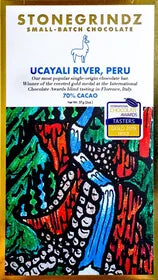
Ucayali River, Peru 70% is tangy, nutty and a little floral. With it, or any of our bars, try letting a square sit on your tongue instead of chewing it, and you’ll feel the cacao butter melt.
Is white chocolate just cacao butter?
No. It’s cacao butter with milk and sugar, and none of the ground bean that makes chocolate brown. US rules say white chocolate must contain at least 20% cacao butter, at least 14% milk solids and no more than 55% sweetener.
That’s why it tastes milky and sweet instead of chocolaty.
Can chocolate contain other fats?
In the US, no. Chocolate can’t contain any fat except cacao butter and a limited amount of milk fat. In the EU, a little can be swapped in, as long as the label says so.
| Where | What the rules allow |
|---|---|
| United States | Only cacao butter and a limited amount of milk fat. US rules for dark chocolate, which the law calls “sweet chocolate,” spell that out. A product made with other vegetable fats must be sold under a different name, such as “sweet chocolate and vegetable fat coating.” |
| European Union | Up to 5% of six other plant fats, including shea and palm oil, as long as the label says “contains vegetable fats in addition to cocoa butter.” |
It comes down to cost. The International Cocoa Organization calls cacao butter “the most expensive of the major ingredients in a chocolate recipe,” so there’s always a pull to replace some of it with less costly fats.
What is deodorized cacao butter?
Natural cacao butter keeps a light chocolate aroma from the bean. Deodorized cacao butter has been treated with steam to strip those aroma compounds out. Cooks and makers choose it when they want the texture of cacao butter without any chocolate smell, as in a white chocolate that should taste mostly of milk and vanilla.
The fat itself stays the same. A 1970 study of deodorized cocoa butter found the treatment didn’t change its makeup in any significant way.
We want that light aroma of the bean in our bars, so we use the natural kind. In the words of our co-owner:
“Our cacao butter is natural, not deodorized.”
— Steven Shipler Jr., co-owner of Stone Grindz
Can you cook with cacao butter?
Yes. Despite the name, it has no dairy in it. Buy cacao butter labeled for food, since some is sold for skin care instead. Melt it gently, in a bowl over barely simmering water or in short bursts in the microwave, stirring until the last pieces just disappear. It sets much firmer than butter or oil, so swap it in for only part of the fat. Pastry chef Penny Stankiewicz said in a Martha Stewart article that “replacing some of the oil in a vegan brownie or other baked good with cacao butter works well.”
Cacao butter costs more than butter or oil, so save it for recipes where its firm set matters, like vegan baking.
How do we make our chocolate?
Here in Arizona, our tiny team roasts the cacao beans, then stone-grinds them with the sugar and our natural cacao butter. The nibs turn in the stone grinder for 72 hours, sometimes up to four days, depending on the grind. The long grind makes the chocolate smooth.
Keep reading: How chocolate is made · Cacao vs cocoa · The Cacao Library
Try it: Ucayali River, Peru 70% · Ambanja, Madagascar 70% · Ancient Ecuador 85%
Sources
- International Cocoa Organization, “Processing Cocoa,” updated Sep 14, 2021, and FAQ, updated Sep 18, 2020, read Nov 5, 2026
- Suri and Basu, “Heat resistant chocolate development for subtropical and tropical climates: a review,” Critical Reviews in Food Science and Nutrition 62:5603–5622, 2022 (doi:10.1080/10408398.2021.1888690), read Nov 5 and Nov 16, 2026
- USDA FoodData Central, “Oil, cocoa butter,” FDC ID 171421 (SR Legacy), read Nov 5, 2026
- Lipp and Anklam, “Review of cocoa butter and alternative fats for use in chocolate, Part A: Compositional data,” Food Chemistry 62(1):73–97, 1998 (doi:10.1016/S0308-8146(97)00160-X), read Nov 5, 2026
- Merriam-Webster, “cacao butter,” read Nov 5, 2026
- America’s Test Kitchen, “How to Fake Couverture (Dipping) Chocolate,” read Nov 5, 2026
- Martha Stewart, “What Is Cacao Butter and Why Is It So Popular With Pastry Chefs?” (as published on AOL), read Nov 5, 2026
- 21 CFR Part 163, Cacao Products, sections 163.111, 163.123, 163.124 and 163.153 (eCFR, up to date as of Nov 3, 2026), read Nov 5, 2026
- Directive 2000/36/EC, relating to cocoa and chocolate products, Jun 23, 2000, Article 2 and Annex II, read Nov 5, 2026
- Rostagno, Reymond and Viani, “Characterisation of deodorised cocoa butter,” International Chocolate Review, 1970, read Nov 5, 2026
- Steven Shipler Jr., co-owner of Stone Grindz, on how we grind our chocolate (Nov 2, 2026), that our beans are organically farmed (Nov 2, 2026) and the cacao butter we use (Nov 11, 2026)
- Our product listings for Ucayali River, Peru 70%, Ambanja, Madagascar 70% and Ancient Ecuador 85% (ingredients and tasting notes), read Nov 5, 2026


