



How is chocolate made?
Chocolate is made from the seeds of the cacao tree. Farmers ferment and dry the seeds. A chocolate maker then roasts them, cracks them and blows away the shells, grinds the cracked pieces (the nibs) with sugar until smooth, and tempers the chocolate so it sets glossy and snaps.
We’ve made chocolate this way in Arizona since 2012.

What happens on the cacao farm?
Farmers cut ripe pods open and scoop out the seeds in their sweet white pulp. The seeds ferment in boxes or heaps for a few days, and that’s where chocolate flavor begins. Our page on what cacao is covers fermenting in detail.
Then the beans dry in the sun for about a week before they’re bagged and shipped. We can’t ferment beans ourselves, so we choose our farms very carefully.
Why are cacao beans roasted?
Roasting builds chocolate flavor and loosens the shell. In a 2022 study, food scientists who tested a range of roasts found that time and temperature changed how bitter the chocolate tasted and how much people liked it.
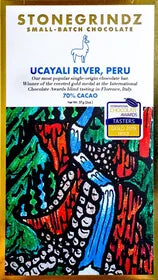
Our Ucayali River, Peru 70% and Ambanja, Madagascar 70%, two of our single-origin chocolate bars, get a very light roast. Our Ancient Ecuador 85% gets a medium roast for a rich, fudgy, toasty flavor, and so do our cacao nibs.
What is winnowing?
Winnowing is cracking the roasted beans and blowing away the shells. The shell is 10% to 17% of a bean’s weight, a 2020 review found, and US standards allow cacao nibs no more than 1.75% shell. The nibs go on to become chocolate, and we turn the shells into cacao tea.

How do cacao nibs become chocolate?
Ground nibs turn into a thick liquid called chocolate liquor. Despite the name, there’s no alcohol in it. US rules require it to be 50% to 60% cacao fat. Sugar and cacao butter go in next, and everything grinds until the particles are under about 30 microns, too small for your tongue to feel.
In our kitchen, that happens between granite stones for 72 hours, sometimes up to four days, depending on the grind.

What is conching?
Conching is the long, warm stirring that finishes chocolate’s flavor and texture. Rodolphe Lindt developed it in Bern in 1879. Conching also drives off the vinegary notes left from fermenting, a 2024 study found. Our stone grinders do both jobs at once: they grind the chocolate smooth and conche it. We give ours more time in the stones than most makers do, adjusted for each origin, so more of the sour, vinegary acids from fermenting can evaporate. That’s what Steven means by a heavy conche:
“Light roast, heavy conche on the Peru and Madagascar, and a nice medium, fudgy, rich, toasty roast on the Ecuador.”
— Steven Shipler Jr., co-owner of Stone Grindz
What is tempering?
Tempering is melting and cooling chocolate through a precise set of temperatures so its cacao butter sets in one particular crystal form. That’s what gives a bar its gloss and crisp snap.
Skip tempering and the bar sets dull, without a crisp snap; our page on Dubai chocolate shows how to temper a homemade bar. Once ours is tempered, we pour it into molds, let it set and wrap it.

What is bean-to-bar chocolate?
Bean-to-bar means one maker does every step after the farm: roasting, winnowing, grinding, tempering and molding.
Is “dark chocolate” a legal term?
Not in the US. The FDA sets minimums for bittersweet and semisweet chocolate (at least 35% chocolate liquor) and for milk chocolate (at least 10%). There’s no standard for “dark”; our page on what 70%, bittersweet and semisweet mean shows how to read the label instead.
How long does it take to make chocolate?
On the farm, fermenting takes a few days and drying about a week. In our kitchen, the grind alone takes 72 hours, sometimes up to four days, and roasting, winnowing, tempering, molding and wrapping come on top of that, and all that time is a big part of why craft chocolate costs more.
From pod to bar
| Step | What changes |
|---|---|
|
Fermenting On the farm, about 2 to 5 days |
Flavor starts to form, and the seed can no longer sprout |
|
Drying On the farm, about a week |
Moisture falls from about 60% to about 7.5% |
|
Roasting In our kitchen, a roast for each origin |
Chocolate flavor develops, and the shell loosens |
|
Winnowing In our kitchen, right after roasting |
The shells, 10% to 17% of the bean, come off |
|
Grinding and conching In our kitchen, 72 hours, sometimes up to four days, between granite stones |
Ground too fine for your tongue to feel, and vinegary flavors fade |
|
Tempering and molding In our kitchen, the last step |
Cacao butter sets in the right crystal form, so the bar is glossy and snaps |
Keep reading: How to taste chocolate like a judge · What is cacao? · The Cacao Library
Try it: Ucayali River, Peru 70% · Ancient Ecuador 85% · Ambanja, Madagascar 70%
Sources
- ICCO, Harvesting and post-harvest
- McClure, Hopfer and Grün, “Optimizing consumer acceptability of 100% chocolate through roasting treatments and effects on bitterness and other important sensory characteristics,” Current Research in Food Science 5:167–174, 2022 (doi:10.1016/j.crfs.2022.01.005)
- Rojo-Poveda et al., Nutrients 12(4):1123, 2020 (doi:10.3390/nu12041123)
- 21 CFR Part 163, Cacao Products (eCFR, current as of Oct 1, 2026), sections 163.110, 163.111, 163.123 and 163.130
- Malvern Panalytical, application note AN151124, Nov 24, 2015
- Chocosuisse, “History”, read Oct 30, 2026
- Guckenbiehl et al., Current Research in Food Science 9:100909, 2024 (doi:10.1016/j.crfs.2024.100909)
- Chen et al., Nature Communications 12:5018, 2021 (doi:10.1038/s41467-021-25206-1)
- Steven Shipler Jr., co-owner, on our roasts and conche (Oct 31, 2026); stone-grinding times from Steven, Nov 2, 2026


