


How do you taste chocolate?
Slowly, and with your nose as much as your tongue. Break off a small piece and smell it. Then let it melt on your tongue instead of chewing, and notice how the flavor changes from the first taste to the finish.
Our chocolate has won 48 awards in blind judging, so we’ve spent years thinking about what judges notice.
How do chocolate judges taste?
At the International Chocolate Awards, where 43 of our awards come from, judges taste without knowing whose chocolate is in front of them. They start with what the competition calls the pleasure principle: decide first if you like it, then work out why.
Judges taste about 15 samples a session and never more than 20, because the competition found that judges’ palates tire after that many. Sessions last an hour and a half. Between samples, judges clear their mouths with water, bread, apples, crackers and the competition’s favorite, a soupy polenta. We have yet to see anyone bring polenta to a home tasting.

How do you set up a chocolate tasting at home?

- Pick 3 to 5 bars, enough to compare without it turning into work.
- If the bars have been in the fridge, let them come back to room temperature in their wrapper first.
- Taste blind if you can: have someone unwrap and number them.
- Keep water and plain crackers nearby, and take a sip between bars.
- Write down a few words for each before anyone talks about it.
What should you look and listen for?
Before you taste, look at the surface and break a piece in half. A glossy surface and a crisp snap mean the chocolate was tempered well: carefully melted and cooled so its cocoa butter set in the right crystal form. A gray-white haze or white speckles are bloom, which is harmless but means the bar got warm or damp at some point, and our page on why chocolate turns white explains both kinds.

Why does smell matter so much?
Because much of what we call flavor is really smell. As you breathe out, aromas rise from the back of your mouth into your nose. Try it: pinch your nose, put a piece on your tongue, and notice that it tastes mostly sweet and bitter. Let go, and the chocolate comes back in full color.
So smell each piece before you taste it, and breathe out through your nose while it melts.
Why let chocolate melt instead of chewing it?
Cocoa butter melts at about 93°F (34°C), just under body temperature. Held on your tongue, a piece melts slowly and gives up its flavor a little at a time. Chew it and you skip straight to the end.
How do you describe what you taste?
Start broad, with words like fruity, nutty, roasty, floral or earthy, then get specific. Our three single-origin bars, each made with beans from one place, carry these tasting notes:
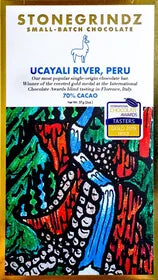
- Ucayali River, Peru 70%: mocha, cedar, dark cherry, caramel and anise
- Ancient Ecuador 85%: chocolate ice cream and roasted peanut
- Ambanja, Madagascar 70%: citrus, dulce de leche and shortbread cookie
The cherry and the citrus come from the beans themselves and from how they were fermented and roasted. Nothing is added to put them there: each bar is just cacao beans, organic cane sugar and organic cacao butter.

What is single-origin chocolate?
Single-origin chocolate is made from cacao grown in one place. That place can be a country, a region or a single farm, and the bar tastes like where it came from. Ours come from the Ucayali River in Peru, the Hacienda Victoria farm in Ecuador and the Ambanja region of Madagascar. Tasting all three side by side is the quickest way to learn how much place matters, and our guide to single-origin chocolate explains what the label tells you.

Keep reading: How to store chocolate (in Arizona heat) · How chocolate is made, from bean to bar · The Cacao Library
Try it: Ucayali River, Peru 70% · Ancient Ecuador 85% · Ambanja, Madagascar 70%
Sources
- International Chocolate Awards, “Judging system and forms” (enter.chocolateawards.com, the competition’s published judging notes from 2013 and 2014) and “About us” (internationalchocolateawards.com, updated 2023), read Oct 30, 2026
- Chen et al., Nature Communications 12:5018, 2021 (doi:10.1038/s41467-021-25206-1)
- Our product listings for Ucayali River, Peru 70%, Ancient Ecuador 85% and Ambanja, Madagascar 70% (tasting notes), read Oct 30, 2026


