

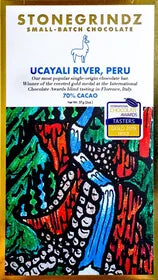
Stone-ground chocolate is chocolate whose cacao was ground between stones instead of the steel rollers most big factories use. The name covers two kinds: Mexican-style chocolate, traditionally ground on stone mills and left gritty on purpose, and smooth chocolate ground for hours or days under granite wheels in a stone grinder, sometimes called a melanger.

We make the second kind, and it’s where our name comes from: every batch of Stone Grindz chocolate turns under granite stones in our Arizona kitchen for 72 hours, sometimes up to four days.
On this page: Why some is gritty · How it gets silky · Grinding and flavor · Is it better? · How to tell them apart · How to use the gritty kind · Bean-to-bar? · How we make ours
Why is some stone-ground chocolate gritty?
Because it’s meant to be. Traditional Mexican-style chocolate is ground coarsely with sugar and pressed into shape, so you can still feel the sugar when you bite in. Much of it is made for drinking and sold as discs or tablets for hot chocolate.
How does chocolate get silky?
By grinding the cacao and sugar so fine that your tongue can’t feel the pieces. Chocolate makers aim to keep most particles under about 30 microns, or 0.03 of a millimeter, according to Malvern Panalytical, which makes instruments that measure them. When too many are bigger than that, tasters start rating the chocolate lower. A stone grinder gets there slowly, with two granite wheels rolling over a granite slab.


Does stone grinding change the flavor too?
Yes. Long, warm stirring, which chocolate makers call conching, finishes chocolate’s flavor and texture: it drives off the vinegary edge left over from fermenting the beans and makes the chocolate smoother and runnier when melted, as a 2024 study in Current Research in Food Science explains. In a stone grinder, that happens while the stones grind, so our chocolate gets both at once. We let ours run longer than many makers do, sometimes four days in all, so more of those sharp, sour notes evaporate. We balance it for each origin, so our Peru and Madagascar bars keep their tang and citrus. Our guide to how chocolate is made has more on conching and where it came from.
Is stone-ground chocolate better?
Neither is better; they’re made for different things. Gritty Mexican-style chocolate is wonderful in a mug, and silky stone-ground chocolate is for a square that melts slowly on your tongue. We’re partial to the slow melt.
How can you tell which kind you’re buying?
Read the words around “stone ground” on the label:
| If the label says | You’re probably buying |
|---|---|
| Mexican-style, discs, tablets, rustic or “for hot chocolate” | The gritty kind |
| Conched, melanger or a grind measured in hours or days | The smooth kind |
Or let a piece melt on your tongue: the gritty kind leaves a faint sandy feel behind.
How do you use gritty stone-ground chocolate?
Mostly in a mug. Chop a disc or tablet, and whisk the pieces into hot milk over low heat until they melt; the package usually says how much milk to use. Expect a little texture at the bottom of the cup; that’s normal for this kind. For a smooth cup made from cacao powder instead, try our hot cacao recipe.
Is stone-ground the same as bean-to-bar?
No. Stone-ground describes the tool. Bean-to-bar means the maker turned the cacao beans into chocolate themselves, instead of melting down chocolate someone else made. We’re both.
How do we make our stone-ground chocolate?
Every bar goes through the same steps. We roast the beans on perforated sheet pans in a convection oven, crack them and blow away the shells, then grind them under granite stones for 72 hours, sometimes up to four days. The roast changes with the origin: our Peru and Madagascar beans get a very light roast, and our Ecuador beans a medium one.

To taste how much the beans and the roast matter, try our Ancient Ecuador 85%, which tastes of chocolate ice cream and roasted peanut, next to our Ambanja, Madagascar 70%, bright with citrus. Both are ground on the same stones.
Keep reading: How chocolate is made, from bean to bar · What is cacao? · The Cacao Library
Sources
- Malvern Panalytical, application note AN151124, “Using Mastersizer 3000 to measure the particle size distribution of chocolate,” Nov 24, 2015, read Nov 1, 2026.
- Guckenbiehl et al., “Conching of dark chocolate,” Current Research in Food Science 9:100909, 2024, read Nov 1, 2026.
- Our roasts, grind and conche: Steven Shipler Jr., co-owner, Oct 31, Nov 1 and Nov 2, 2026; our guide How chocolate is made; our product listings for Ancient Ecuador 85% and Ambanja, Madagascar 70%, read Nov 1, 2026.


