

Hot cacao is hot cocoa made with cacao powder. For one mug, whisk 1½ tablespoons of cacao powder, 1½ tablespoons of sugar and a pinch of salt into 2 tablespoons of hot water in a small pan, let it bubble over low heat for a minute, then add a cup of milk and heat it until it steams. Jump to the recipe

On this page: Hot cacao · Make it richer · Vegan · Sipping chocolate · A flavor for each bar · Aztec-style · The richest cup · Add-ins · Hot cacao vs hot chocolate · Make a mix
Hot cacao recipe (1 mug)
Ingredients
- 1½ tablespoons raw cacao powder, or any unsweetened cocoa powder
- 1½ tablespoons sugar (light brown sugar adds a little caramel flavor)
- A pinch of salt
- 2 tablespoons hot water
- 1 cup whole milk
- ¼ teaspoon vanilla extract
Steps
- In your smallest saucepan, whisk the cacao powder, sugar and salt with the hot water until it’s a smooth, glossy paste.
- Set the pan over low heat and let the paste bubble gently for about a minute, whisking. If it gets too thick, add a splash of the milk.
- Whisk in the milk and heat it over medium-low for 3 to 5 minutes, until it steams and tiny bubbles form at the edge. Don’t let it boil.
- Take it off the heat, stir in the vanilla, and whisk hard for a few seconds to froth it. Taste, and add more sugar if you like it sweeter.

No pan? In a mug, stir the cacao, sugar and salt into the 2 tablespoons of hot water to make the paste. Microwave the milk separately for about 1½ minutes, stir it into the paste a little at a time, then add the vanilla.
| Ingredient | 1 mug | 4 mugs |
|---|---|---|
| Cacao powder | 1½ Tbsp | 6 Tbsp |
| Sugar | 1½ Tbsp | 6 Tbsp |
| Salt | A pinch | ¼ tsp |
| Hot water | 2 Tbsp | ½ cup |
| Milk | 1 cup | 4 cups |
| Vanilla | ¼ tsp | 1 tsp |
For 4 mugs, use a medium saucepan; the milk takes longer to steam over medium-low, about 12 to 15 minutes.
Why make a paste with hot water first?
Cocoa powder clumps when it hits a pan of milk, and hot water brings out its flavor. America’s Test Kitchen puts it this way: “Water has the effect of releasing the cocoa powder’s fruit, chocolate, and coffee flavor nuances.” The paste also dissolves the sugar evenly, Sugar Spun Run notes, so the milk only has to warm up.
How do you make hot chocolate with cacao powder?
Make the hot cacao above, and once the milk is steaming at step 3, whisk in ¾ to 1 ounce (20 to 28 g) of finely chopped dark chocolate until it melts. That’s about half of one of our bars. It makes the drink thicker and richer. Love and Lemons uses 1 ounce of 70% dark chocolate per cup, and the richest recipes go up to 2 ounces.
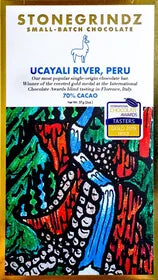
Our Ucayali River, Peru 70% is the one we’d chop for this. It’s vegan friendly, so it works in the vegan recipe below too.

How do you make hot cacao richer?
Cream makes the biggest difference, then chocolate, then espresso powder:
- Swap ¼ cup of the milk for heavy cream. Cook’s Illustrated’s Decadent Hot Chocolate uses 3 parts milk to 1 part cream.
- Melt in chocolate, as above. Cocoa powder has had part of its natural fat, cacao butter, pressed out, and a little chopped bar chocolate puts some back.
- Whisk ⅛ teaspoon of instant espresso powder into the paste. King Arthur Baking says a little makes chocolate taste more chocolaty without tasting like coffee.
Brown sugar in place of white adds a caramel, molasses note, says The Kitchn. A tiny extra pinch of salt takes the edge off bitterness: a 1997 study in the journal Nature found that salt blocks bitterness more than it blocks sweetness.
Vegan hot cacao (1 mug)
Ingredients
- 1½ tablespoons cacao powder
- 1 tablespoon maple syrup, or 1½ tablespoons cane sugar
- A pinch of salt
- 2 tablespoons hot water
- ¾ cup oat milk plus ¼ cup canned light coconut milk (or 1 cup soy milk)
- ¼ teaspoon vanilla extract
Steps
- In your smallest saucepan, whisk the cacao powder, sweetener and salt with the hot water into a smooth paste.
- Let it bubble gently over low heat for about a minute, whisking.
- Whisk in the plant milk and warm it over medium-low for 3 to 5 minutes, until it steams. Keep it below a boil.
- Off the heat, stir in the vanilla and froth it with a whisk or a frother.
Most vegan recipes also melt in dairy-free chocolate. For a thicker cup, whisk about ¾ ounce of chopped vegan dark chocolate into the steaming milk at step 3.

What is sipping chocolate?
Sipping chocolate is melted chocolate thinned with just enough milk to pour. It’s also called drinking chocolate or European hot chocolate, and it’s served in small cups because it’s so rich. Hot cocoa is mostly milk with a spoonful of powder; sipping chocolate is about one-third chocolate. Dandelion Chocolate, a chocolate maker in San Francisco, calls its European drinking chocolate its most popular drink, and it uses 2 parts milk to 1 part chocolate by weight.
How do you make European sipping chocolate?
Melt a bar of dark chocolate into hot milk. One of our 57-gram (2 oz) bars and half a cup of whole milk make two small cups. That’s Dandelion’s ratio.

Ingredients (2 small cups)
- 1 bar (57 g, 2 oz) of 70% dark chocolate, like our Ucayali or Ambanja, chopped fine
- ½ cup (120 ml) whole milk
- A tiny pinch of salt
Steps
- Chop the bar as fine as you can and put it in a small heatproof bowl or pitcher. Small pieces melt evenly.
- Heat the milk in a small saucepan until it steams, with tiny bubbles at the edge. Don’t let it boil.
- Pour about a third of the milk over the chocolate and whisk until it turns shiny and smooth. Adding the milk a little at a time keeps it silky; it’s the same method used for the ganache inside a chocolate truffle.
- Whisk in the rest of the milk in two additions, then the salt. It cools as it melts the chocolate, so pour it back into the saucepan and warm it over low heat for a minute, stirring. Pour it into two small cups, about ⅓ cup each; espresso cups or small teacups are the right size.
Thicker, Spanish-style: whisk 1½ teaspoons of cornstarch into the cold milk, then heat it, whisking, and let it simmer for 1 to 2 minutes until it thickens before it goes over the chocolate. That’s how Spain and Italy make their thick hot chocolate, and it’s thick enough to dunk a churro.
Lighter, with water: use ½ cup of hot water instead of milk. It’s thinner, and you taste more of the chocolate’s fruit, says the French chocolate maker Valrhona.
With our 85%: Ancient Ecuador has more cacao and less sugar, so it makes a thicker, more bitter cup. Add 2 extra tablespoons of milk, and dissolve about 2 teaspoons of sugar in it as it heats. Darker chocolate needs more liquid to stay smooth.

What flavors go with sipping chocolate?
Match the flavor to the bar, and steep it in the milk first. Warm the milk with the spices until it steams (add tea once the milk is hot), then take it off the heat, cover it and let it sit for the time given below. Strain it, and reheat it before you pour it over the chocolate.
Ambanja, Madagascar 70%, with cardamom and orange
Madagascar cacao is known for bright, fruity flavor, and our Ambanja, Madagascar 70% tastes of citrus, dulce de leche and shortbread cookie. The Belgian chocolate maker Callebaut suggests cardamom and mandarin with its own Madagascar chocolate.
Crack 2 green cardamom pods open with the flat of a knife, and steep them with a wide strip of orange peel in the milk for 5 minutes; for a little heat, add a few cracked pink peppercorns too. Top with vanilla whipped cream: whip 1 cup of cold heavy cream with 2 tablespoons of sugar and ½ teaspoon of vanilla until soft peaks form, curling over at the tips. That’s Sally’s Baking Addiction’s recipe, and it tops about 8 mugs.

Ucayali River, Peru 70%, with Earl Grey and cherry
Our Ucayali River, Peru 70% is tangy and nutty, with a floral edge and notes of dark cherry and anise. Earl Grey tea is flavored with bergamot, a floral citrus, and Callebaut pairs its own Peru chocolate with bergamot.
Steep 1 Earl Grey tea bag in the hot milk for 4 minutes, off the heat, then lift it out gently; squeezing it makes the milk bitter. Top with whipped cream and a dark cherry, fresh or from a jar. To bring out the anise instead, steep ½ teaspoon of crushed aniseed and a strip of orange peel for 5 minutes.
Ancient Ecuador 85%, with cinnamon and chile
Our Ancient Ecuador 85% tastes of chocolate ice cream and roasted peanut, and it can take spice. For cinnamon and chile, make the Aztec-style cup below. Or play up its toasty, nutty side: whisk 2 teaspoons of malted milk powder into the milk as it heats.
How do you make Aztec-style hot chocolate?
Aztec-style hot chocolate is dark chocolate spiced with chile and frothed until foamy. The Aztecs and Maya drank theirs on the bitter side, flavored with chile, vanilla, honey and flowers, sometimes thickened with corn, and frothed by pouring it from one vessel to another from a height, according to the Penn Museum and the historian Marcy Norton. Sugar and cinnamon came later, with the Spanish; our page on when chocolate was invented follows the drink from the Amazon to the first bar. Our cup takes chile and vanilla from the original, and sugar and cinnamon from the Spanish.
Ingredients (2 small cups)
- 1 bar (57 g, 2 oz) of 85% dark chocolate, like our Ancient Ecuador, chopped fine
- ½ cup plus 2 tablespoons whole milk
- A 1-inch piece of cinnamon stick
- A tiny pinch of cayenne, or a small dried red chile
- 2 teaspoons sugar, ideally turbinado (coarse, light brown cane sugar) or grated piloncillo (Mexican unrefined cane sugar)
- ¼ teaspoon vanilla

Steps
- Heat the milk with the cinnamon and chile until it steams, then cover it off the heat for 10 minutes.
- Strain it, stir in the sugar, and reheat until it steams.
- Put the chopped chocolate in a small heatproof bowl. Pour about a third of the hot spiced milk over it and whisk until glossy, then add the rest in two additions, as in the sipping chocolate above. Stir in the vanilla, then pour it back into the saucepan and warm it over low heat for a minute, stirring.
- Froth it the old way: pour it back and forth between two cups, lifting the top one higher each time. A molinillo (a wooden Mexican whisk) or a milk frother works too.
Turbinado adds a light caramel flavor, and piloncillo a deeper, earthy one. For a cup closer to the ancient drink, skip the cinnamon, use ½ cup plus 2 tablespoons of hot water instead of milk, and sweeten with about 2 teaspoons of honey. For grown-ups, stir about a tablespoon of aged rum or whisky into each cup.
What’s the most decadent hot chocolate you can make?
The most decadent cup we make is a whole bar of dark chocolate melted into milk and cream, deepened with a little cacao powder, brown sugar and espresso, and topped with whipped cream steeped with cacao nibs. The cream needs a night in the fridge; the cup takes about 10 minutes.
The night before: cacao nib whipped cream
Bring 1 cup of heavy cream and 1 tablespoon of sugar to a boil, turn off the heat, and stir in ¼ cup of cacao nibs, which are crushed roasted cacao beans. Cover and steep for 30 minutes; Saveur warns that steeping longer brings out bitterness. Strain, chill for at least 6 hours, then whip until soft peaks form. It makes enough for about 8 mugs, so there’s plenty left for berries or another round.

The cup (2 small cups, or 1 generous one)
- 1 bar (57 g, 2 oz) of 70% dark chocolate, chopped fine; our Ucayali makes a bright, fruity cup
- ⅓ cup whole milk plus 3 tablespoons heavy cream
- 1 teaspoon cacao powder
- 1 teaspoon light brown sugar
- ⅛ teaspoon instant espresso powder
- 1 tablespoon hot water
- ¼ teaspoon vanilla
- Flaky salt
Steps
- Put the chopped chocolate in a small heatproof bowl or pitcher.
- In a small saucepan, whisk the cacao powder, brown sugar and espresso powder with the hot water into a paste, and let it bubble over low heat for about 30 seconds. Whisk in the milk and cream and heat until it steams; don’t let it boil.
- Pour it over the chocolate in three additions, whisking until glossy, as in the sipping chocolate above. Stir in the vanilla and a few flakes of salt. It cools as it melts the chocolate, so pour it back into the saucepan and warm it over low heat for a minute, stirring.
- Pour into warmed cups, top with a big spoonful of the nib cream, and if you have a little more chocolate, shave some over the top.
For a deeper cup, use our Ancient Ecuador 85% and add 2 extra tablespoons of milk and another teaspoon of brown sugar.
Rather have marshmallows? Homemade ones melt into a soft, creamy layer, and King Arthur Baking’s recipe is a good place to start. Or try Wisconsin Cheese’s mascarpone whipped cream: whip ¾ cup of mascarpone, 1 cup of heavy cream, 2 tablespoons of honey, 1 teaspoon of vanilla and a pinch of salt together until it holds soft peaks.
What can you add to hot chocolate to make it better?
Amounts are per mug of the basic recipe above.
| Add | How much |
|---|---|
| Heavy cream | ¼ cup, in place of ¼ cup of the milk |
| Dark chocolate | ¾ to 1 oz, chopped |
| Instant espresso powder | ⅛ teaspoon |
| Ground cinnamon and cayenne | ¼ teaspoon cinnamon and a tiny pinch of cayenne |
| Peppermint extract | ⅛ teaspoon |
| Peanut butter | 1 tablespoon |
| Orange | A strip of peel |
| Bourbon or dark rum | 1 to 2 tablespoons |
Whisk the spices, espresso powder and peanut butter into the paste at step 1. Steep the orange peel in the milk as it heats, and stir in extracts and spirits off the heat, with the vanilla.
What’s the difference between hot cacao, hot cocoa and hot chocolate?
The names overlap, and the difference is mostly what goes in. Britannica’s dictionary lists hot cocoa as another name for hot chocolate. Many recipe writers draw a line: hot cocoa is made from cocoa powder, and hot chocolate has melted chocolate in it.
“Hot cacao” has no official definition. In practice it means hot cocoa made with powder sold as cacao, usually natural rather than Dutch-process (more on those just below), so it tastes brighter and a little more bitter. Cacao powder and cocoa powder are the same food: ground cacao beans with part of their fat pressed out. Our guide to cacao vs cocoa covers the label wording, and our page on caffeine in chocolate and cacao shows how much caffeine each cup has.
Sipping chocolate is the thickest of them all, with the most chocolate (more on it above).

Should you use natural or Dutch-process cocoa?
Either works. Dutch-process cocoa has been treated with alkali, which makes it darker and milder; US labels say “processed with alkali.” Natural cocoa keeps the bean’s acidity and fruit, so it tastes brighter. America’s Test Kitchen and Cook’s Illustrated use Dutch-process for a mellow cup, and Sugar Spun Run prefers natural.
We use natural, and if it tastes sharp to you, a little more sugar or a splash of cream rounds it off. Our powder is also raw, which means unroasted, and it works the same way in every recipe here.
Which plant milk makes the best vegan hot cacao?
Oat milk with a little canned light coconut milk. Together they’re about as creamy as half-and-half, says Rainbow Plant Life, and that’s the mix we use. How the others compare, according to vegan recipe writers:
| Milk | What they found |
|---|---|
| Oat | Creamy to some, too thin on its own to others; homemade oat milk can thicken too much when heated |
| Soy | Thicker and richer than almond |
| Light canned coconut | Creamy; The Vegan 8 tastes no coconut, while A Couple Cooks finds it too strong |
| Cashew | Creamy, says Cookie and Kate |
| Almond | The most-reviewed vegan recipe uses it (Minimalist Baker), but several others call it thin |
Plant milks labeled “barista” froth best.
Can you make hot cacao with water?
Yes, but it’s thinner and less creamy than with milk. If you use water, use the same paste method and finish with a splash of cream or creamy oat milk.
How do you make a hot cacao mix?
Whisk together ½ cup of cacao powder, ½ cup of sugar and ¼ teaspoon of salt, and keep it in a sealed jar. For each mug, use 3 tablespoons of the mix in place of the cacao, sugar and salt, and follow the recipe above. The jar makes about 5 mugs.

How did we build these recipes?
We started from the highest-rated published recipes and the chefs and chocolate makers behind them, kept what they agree on, and tuned it for our powder and our bars.
- Basic hot cacao: Tastes Better From Scratch, Sugar Spun Run and America’s Test Kitchen.
- Hot chocolate: Love and Lemons, Natasha’s Kitchen, Downshiftology and Preppy Kitchen.
- Vegan: Minimalist Baker, The Vegan 8 and Rainbow Plant Life.
- Sipping chocolate: Dandelion Chocolate and Well Plated, with the thick Spanish and Italian styles from Omar Allibhoy and GialloZafferano.
- The richest cup: Cook’s Illustrated for the cream, Saveur for the nib cream and King Arthur Baking for the espresso.
They agree on about 1 to 1½ tablespoons of cocoa per cup of liquid, a paste before the milk goes in, a pinch of salt, vanilla added off the heat, and no boiling once the milk is in.
Keep reading: What does raw cacao mean? · Cacao vs cocoa · The Cacao Library
Sources
- Tastes Better From Scratch, “Hot Cocoa” (5.0 from 127 ratings), read Oct 31, 2026.
- Sugar Spun Run, “Hot Cocoa” (5.0 from 23) and “Hot Chocolate,” read Oct 31, 2026.
- America’s Test Kitchen, “Hot Cocoa” (4.6 from 12), read Oct 31 and Nov 1, 2026.
- Taste of Home, “Homemade Hot Cocoa” and “Cacao Powder Hot Chocolate,” read Oct 31, 2026.
- Minimalist Baker, “5-Minute Vegan Hot Cocoa” (4.95 from 92), read Oct 31, 2026.
- The Vegan 8, “The Best Vegan Hot Chocolate” (4.99 from 50), read Oct 31, 2026.
- Rainbow Plant Life, “The Best Vegan Hot Chocolate” (5.0 from 39), read Oct 31, 2026.
- Natasha’s Kitchen (4.99 from 245), Downshiftology (4.99 from 64), Love and Lemons (4.91 from 51) and Preppy Kitchen hot chocolate recipes, read Oct 31, 2026.
- A Couple Cooks, Cookie and Kate, Loving It Vegan and Plant-Based on a Budget (plant milks), read Oct 31, 2026.
- King Arthur Baking, “Homemade Hot Chocolate,” read Oct 31, 2026.
- Britannica Dictionary, “hot chocolate,” read Oct 31, 2026.
- 21 CFR Part 163, US standards for cacao products, including cocoa processed with alkali, read Oct 31, 2026.
- Cook’s Illustrated, “Decadent Hot Chocolate” (4.8 from 16), read Nov 1, 2026.
- King Arthur Baking, “Baking with espresso powder” and “Homemade Marshmallows” (4.6 from 83); The Kitchn, “Hot Chocolate” and “What’s the difference: muscovado, turbinado and more,” read Nov 1, 2026.
- Breslin PAS and Beauchamp GK, “Salt enhances flavour by suppressing bitterness,” Nature 387:563, 1997.
- Dandelion Chocolate, European Drinking Chocolate, from Making Chocolate, as published by TASTE; Well Plated, “French Hot Chocolate” (4.74 from 104), read Nov 1, 2026.
- Francisco Migoya, The Elements of Dessert, “Ganache method”; Ricardo, “Cacao percentages,” read Nov 1, 2026.
- Omar Allibhoy, “Spanish hot chocolate”; GialloZafferano, “Cioccolata calda” (4.4 from 248), read Nov 1, 2026.
- Valrhona, “La nouvelle expérience de boisson chocolatée,” 2021, read Nov 1, 2026.
- Callebaut origin chocolates: Madagascar and Peru, read Nov 1, 2026.
- “Jim Graham’s Spiced Hot Chocolate,” from Maricel E. Presilla, The New Taste of Chocolate, 2001; Saveur, “Frozen Hot Chocolate with Cacao Nib Cream,” read Nov 1, 2026.
- Elin C. Danien, “Yom Yom Cacao!,” Expedition 45(2), Penn Museum, 2003; Marcy Norton, “Chocolate para el imperio,” Revista de Estudios Sociales 29, 2008 (Spanish edition of “Tasting Empire,” American Historical Review, 2006); Mexico News Daily on piloncillo, read Nov 1, 2026.
- Wisconsin Cheese, “Hot Chocolate with Mascarpone Whipped Cream”; Sally’s Baking Addiction, “Homemade Whipped Cream” (4.9 from 151), read Nov 1, 2026.
- Add-ins: Budget Bytes, “Spicy Hot Cocoa,” Minimalist Baker, Cookie and Kate, Once Upon a Chef, read Nov 1, 2026.
- Our product listings: 100% Raw Organic Cacao Powder, Ucayali River, Peru 70%, Ambanja, Madagascar 70%, Ancient Ecuador 85% and Cacao Nibs from Ecuador, read Nov 1, 2026.


