

Most chocolate has a little caffeine, and darker chocolate has more. USDA lists about 24 mg of caffeine in a 30 g (about 1 oz) serving of 70–85% dark chocolate, about 6 mg in milk chocolate and none in white chocolate. An 8 oz cup of brewed coffee has about 95 mg.

On this page: Chocolate vs coffee · Dark chocolate by % · Does darker mean more? · Hot chocolate and hot cacao · Cocoa powder · Cacao nibs · Theobromine · Cacao tea
Does chocolate have more caffeine than coffee?
No. Serving for serving, dark chocolate has about a quarter as much caffeine as brewed coffee.

| Food or drink | Serving | Caffeine |
|---|---|---|
| Brewed coffee | 8 fl oz | About 95 mg |
| Black tea, brewed | 8 fl oz | About 47 mg |
| Cola | 12 fl oz can | About 33 mg |
| Dark chocolate, 70–85% | 30 g (1 oz) | About 24 mg |
| Milk chocolate | 30 g (1 oz) | About 6 mg |
| Hot cocoa, USDA’s homemade recipe | 1 cup | About 5 mg |
| White chocolate | 30 g (1 oz) | 0 mg |
Source: USDA’s food database, FoodData Central. The record numbers are listed under Sources.
How much caffeine is in dark chocolate?
About 13 to 26 mg in a 30 g serving, depending on the cacao percentage. These are USDA’s figures, worked out for 30 g, the serving size US nutrition labels use for chocolate:
| Chocolate | Caffeine per 30 g |
|---|---|
| Dark, 70–85% cacao | 24 mg |
| Dark, 60–69% cacao | 26 mg |
| Dark, 45–59% cacao | 13 mg |
| Semisweet chocolate and chips | 19 mg |
| Unsweetened baking chocolate (100%) | 24 mg |
| Milk chocolate | 6 mg |
| White chocolate | 0 mg |
A whole 3.5 oz (100 g) bar of 70–85% dark chocolate has about 80 mg, a little less than a cup of coffee.
Don’t read much into the small differences. USDA’s dark chocolate figures are lab measurements from 2008, with only two or three samples each, so 60–69% edging out 70–85%, or 100% baking chocolate merely matching it, says more about the samples than about the chocolate. The semisweet figure comes from older records, from 1991. The white chocolate figure is calculated, not measured: the only part of the cacao bean in white chocolate is cacao butter, which USDA lists with no caffeine.
Does darker chocolate have more caffeine?
Yes, as a rule. Caffeine sits in the cocoa solids, the part of the bean that isn’t fat, so the more cocoa solids a bar has, the more caffeine it tends to carry. A 2026 study in the Journal of Food Science tested 45 small-batch chocolates from Brazil and found caffeine rose with cacao content. Bars at 70 to 100% averaged about 32 mg per 30 g, nearly two and a half times the 13.5 mg in bars at 30 to 65%. Single bars ranged from about 2 to 60 mg. (We converted the study’s figures to 30 g servings.) Its numbers run higher than USDA’s, a reminder that caffeine varies from one bar to the next.
Where the beans grow plays a part too. A 2024 study of 26 dark chocolates, in the same journal, found that bars made from cacao grown in the Americas had more than 50% more caffeine than bars made from African cacao, comparing the cocoa solids in each bar. The authors caution that their sample was small. And a 2020 study of Nacional, Ecuador’s native cacao, from 85 farms found more caffeine in beans grown in the Amazon region than in beans from elsewhere in Ecuador.
Does hot chocolate have caffeine?
A little: about 5 to 7 mg in a cup made from a mix or syrup, and more when it’s made with real chocolate or plenty of cocoa powder. Recipes use very different amounts of cocoa and chocolate, so cups vary a lot. These figures come from USDA’s recipe calculations and our own math from USDA’s ingredient numbers, not from lab tests of a finished cup:
| Hot drink, 1 cup | Caffeine |
|---|---|
| Hot cocoa from a packet mix, made with water | About 5 mg |
| Hot cocoa, USDA’s homemade recipe | About 5 mg |
| Hot chocolate made with chocolate syrup | About 7 mg |
| Our hot cacao, made with a generous 1½ Tbsp of natural cocoa powder (about 8 g) | About 19 mg |
| Any of these with 30 g of 70–85% dark chocolate melted in | About 24 mg more |
Does cocoa powder have caffeine?
Yes. Cocoa powder is ground cacao beans with part of their fat pressed out, so the caffeine is concentrated. USDA lists a little over 12 mg of caffeine in a tablespoon of natural unsweetened cocoa powder, and about 4 mg in a tablespoon of Dutch-process cocoa, which is treated with alkali to make it darker and milder.
That gap may not be real. Each figure comes from a single sample, in records from 1991, so it doesn’t prove that the alkali treatment removes caffeine. What’s safe to say is that a spoonful of cocoa powder has a small fraction of the caffeine in a cup of coffee. Our guide to cacao vs cocoa explains the label words.
Do cacao nibs have caffeine?
Yes. Nibs are roasted cacao beans broken into pieces, with the shell removed, so they carry the bean’s caffeine and its theobromine (more on that below). USDA has no entry for nibs, but unsweetened baking chocolate is nibs ground smooth, and USDA lists it at about 24 mg per 30 g.
Does chocolate have caffeine or theobromine?
Both, and far more theobromine. Theobromine is a close chemical cousin of caffeine, and its name comes from the cacao tree’s Latin name, Theobroma. USDA lists about ten times as much theobromine as caffeine in 70–85% dark chocolate:
| In 30 g of 70–85% dark chocolate | Amount |
|---|---|
| Theobromine | About 240 mg |
| Caffeine | About 24 mg |

Does cacao tea have caffeine?
A little. Cacao tea, also called cacao husk tea, is brewed from the papery shells that come off roasted cacao beans. A 2026 study of ten husk teas sold in stores measured about 0.9 to 1.9 mg of caffeine per gram of husk. At the study’s strength, 2 grams of husk per 100 mL of water, an 8 oz cup has roughly 4 to 9 mg.
Brew it stronger and it climbs. A 2019 study found up to about 30 mg in an 8 oz cup when finely ground shells were brewed in a stovetop espresso pot. A normal cup still has far less caffeine than coffee or black tea.
From our kitchen
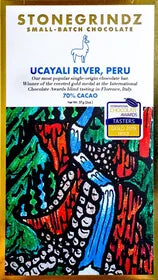
We roast and stone-grind our own cacao beans in Arizona. Our single-origin bars, each made from beans grown in one place, have three ingredients: cacao beans, organic cane sugar and organic cacao butter. If you’re choosing a bar for flavor, our Ucayali River, Peru tastes of dark cherry, caramel and anise, and our Ancient Ecuador tastes of chocolate ice cream and roasted peanut. You’ll find them with the rest of our dark chocolate bars.

For baking and drinking, our raw cacao powder from Ecuador is natural, never Dutch-processed, and it’s the powder in our hot cacao recipe.
Keep reading: What is cacao? · How chocolate is made · How to taste chocolate · The Cacao Library
Sources
- USDA FoodData Central. Chocolate: dark 70–85% (170273), dark 60–69% (170272), dark 45–59% (170271), semisweet (167976), unsweetened baking (167568), milk (167587), white (167571) and cocoa butter (171421). Cocoa powder: natural (169593) and Dutch-process (169594). Hot cocoa: from a mix (2705483), USDA’s homemade recipe (171277) and with chocolate syrup (2705473). Drinks: brewed coffee (171890), black tea (173227) and cola (174852). Read Oct 31, 2026.
- 21 CFR 101.12, reference amounts customarily consumed (30 g for chocolate); 21 CFR Part 163, US standards for cacao products, including unsweetened chocolate.
- Altissimo J, et al., “Chromatographic Profiling of Artisanal Chocolates: Volatile Composition and Methylxanthines as Markers of Cocoa Content,” Journal of Food Science 91(3):e70979, 2026, read Oct 31, 2026.
- Parada T, Pardo P, Saurina J, Sentellas S, Journal of Food Science 89(12):8857–8867, 2024 (caffeine and theobromine in 26 dark chocolates by origin and variety), read Oct 31, 2026.
- Samaniego I, et al., Journal of Food Composition and Analysis 88:103448, 2020 (growing area and caffeine in Ecuadorian cacao; abstract), read Oct 31, 2026.
- Boonchalaem T, Tienprateep P, Boonyapranai K, Molecules 31(10):1697, 2026 (cocoa husk tea), read Oct 31, 2026.
- Rojo-Poveda O, et al., Nutrients 11(4):867, 2019 (cocoa bean shell drinks by brewing method), read Oct 31, 2026.


